
Forex Quant EA V2.0 takes a quant-first approach: trend & regime detection, volatility sanity checks, micro-structure confirmation, and strict risk controls. No martingale, no recovery grid, no “hold and hope.” When conditions are noisy, it simply sits out. When the tape is clean, it acts—then manages the trade like a grown-up.
Below is your full, trader-first guide: what’s inside V2.0, how the logic works, suggested settings, install steps, testing tips, risk playbook, FAQs, and copy-paste meta data for your CMS.
What Is Forex Quant EA V2.0?
Forex Quant EA V2.0 is a MetaTrader 4 Expert Advisor that tries to capture trend-pullback-continuation and breakout behavior on liquid FX pairs (and optionally gold) using a simple but disciplined pipeline:
- Market regime & trend bias
- Volatility gate (ATR)
- Structure confirmation (break–retest or decisive close)
- Lifecycle management (partial TP, trailing, exposure caps)
Best for: Traders who want transparent, rules-based automation with no martingale, realistic stops, and conservative money management.
Target symbols & timeframes
- EURUSD, GBPUSD, USDJPY → M15–H1
- XAUUSD (optional) → M30–H1 (go slower if costs are chunky)
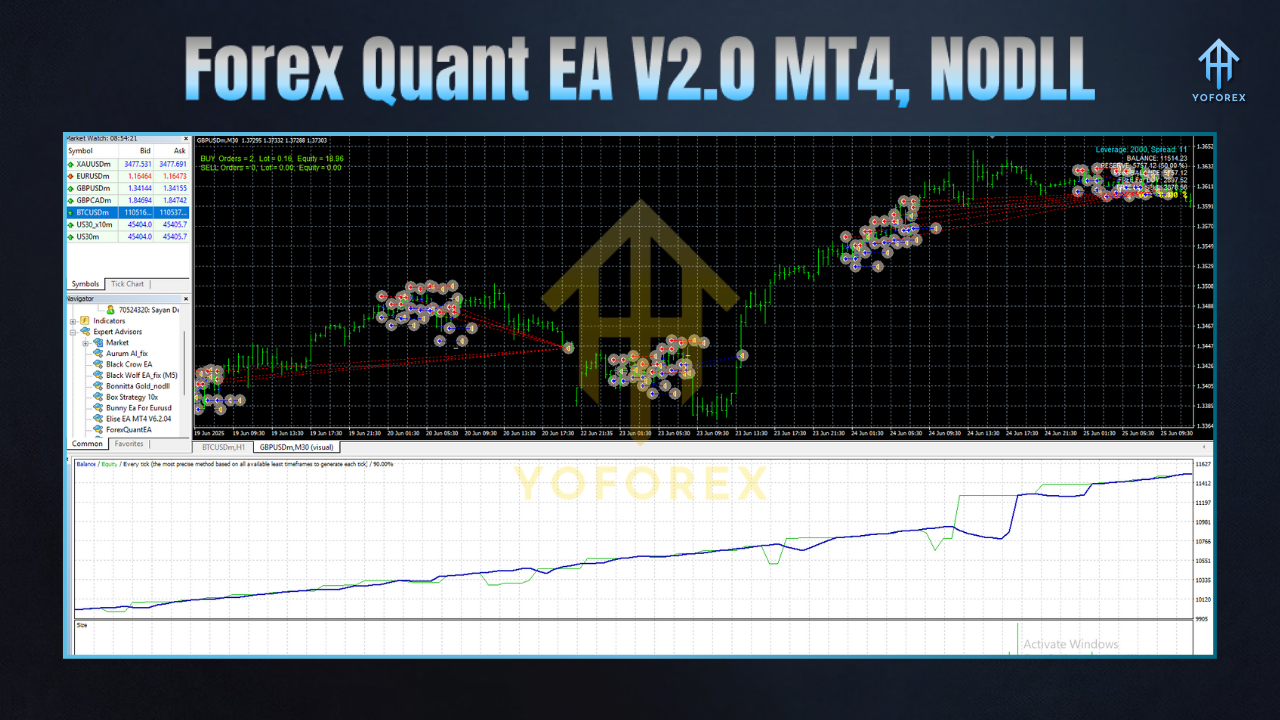
What’s New in V2.0
- Sharper regime filter – Distinguishes trend vs. range more cleanly to reduce counter-trend nibbles.
- Improved ATR gate – Skips low-quality windows when implied SL is silly-wide or ultra-tight.
- Refined confirmation engine – Better break–retest & decisive-close detection with fewer premature triggers.
- Partial-TP + trailing polish – Trailing engages only after +1R, with smoother steps.
- Execution guards – Faster spread/slippage vetoes; happier fills.
- Equity guard upgrade – Cleaner pause/resume behavior around daily loss & floating drawdown limits.
- Logging clarity – Human-readable “why” for entries, exits, and vetoes (great for tuning).
Key Features (At a Glance)
- Quant-style confluence: market regime → trend bias → ATR sanity → structure confirmation
- Two entry modes: Breakout (decisive close) & Pullback continuation (break–retest)
- ATR-aware SL/TP: dynamically sized stops/targets (typ. 1.5×–2.5× ATR)
- No martingale / no grid: optional light add-ons to winners only on fresh confirmation
- Equity guard & daily stop: auto-pause new entries beyond your loss limits
- Spread/slippage caps: instant veto during hostile execution
- Session & news windows: emphasize liquid hours; optionally block high-impact events
- Transparent logs: audit decisions without guesswork
Strategy Logic — Under the Hood
1) Regime & Trend Bias
A dual-MA baseline plus a modest momentum read decides if longs or shorts are even allowed. Optional MTF bias (e.g., M15 entries aligned with H1) avoids fighting the tide.
2) Volatility Gate (ATR)
The EA computes a practical SL using ATR. If the implied stop is too wide (edge diluted) or too tight (likely noise), the setup is skipped. You’re not forced into bad math.
3) Structure Confirmation
- Breakout: a decisive close through a micro-level with follow-through.
- Pullback: break–retest with a confirming close in the trend direction.
No confirmation? No trade.
4) Risk Lifecycle
- Position size = % of equity (not random lots).
- Partial TP around +1R (configurable).
- Trailing behind ATR or last swing once the trade has earned it.
- Optional add-on only if a fresh confirmation appears and exposure caps allow.
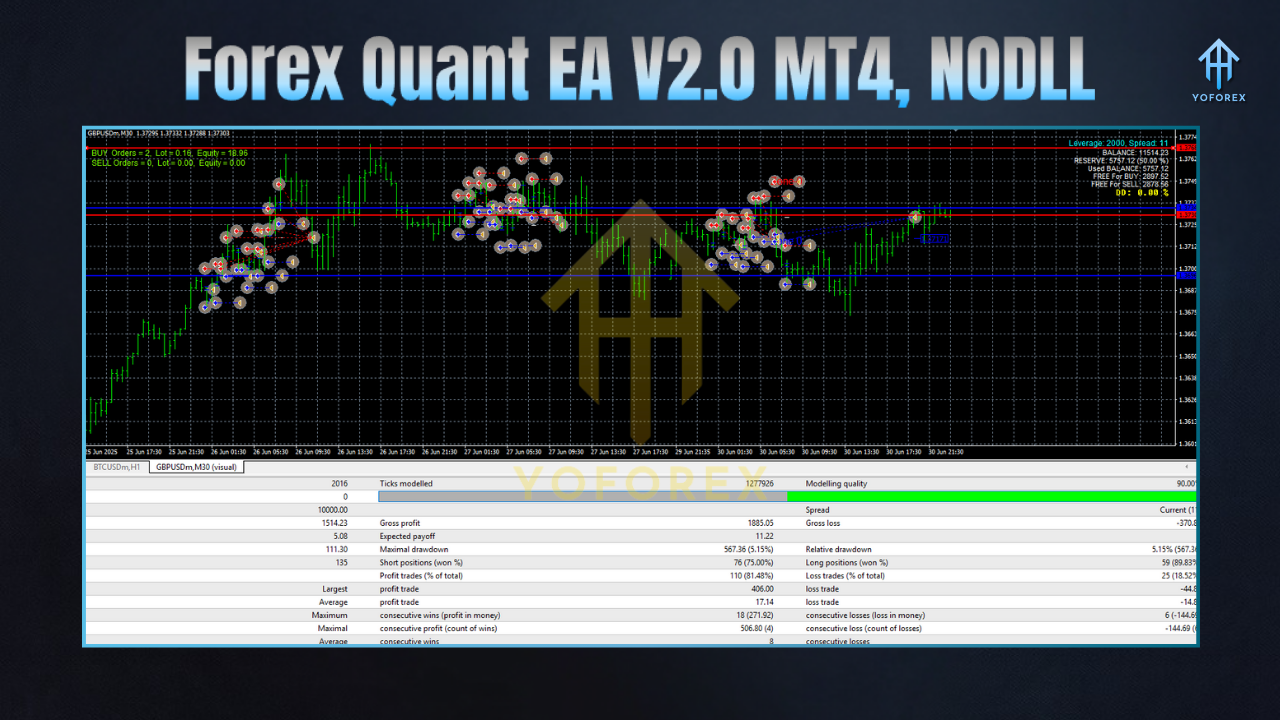
Recommended Settings (Starter Template)
Environment
- Broker: ECN/Raw-spread with stable liquidity
- VPS: Yes (uptime + low latency)
- Leverage: 1:200–1:500 (leverage ≠ edge; position sizing is)
Symbols & Timeframes
- EURUSD / GBPUSD / USDJPY: M15–H1 (H1 calmer, M15 more active)
- XAUUSD (optional): M30–H1 (metals are cost-sensitive)
Risk Controls
- Risk per trade: 0.5%–1.0% (new users: 0.5%)
- Max concurrent positions: 3–5 (all charts)
- Max add-ons per symbol: 1–2 (winners only)
- Daily loss stop: 2%–3% (auto-pause for the day)
- Equity guard (floating DD): 5%–8% (pause new entries until recovery)
Execution Filters
- Max spread (majors): EURUSD ≤ 15–20 pts; GBPUSD ≤ 20–25; USDJPY ≤ 15–20
- Max spread (gold): 35–60 pts (depends on quoting)
- Max slippage: 1–3 pts (align to tick size)
- Sessions: Favor London/NY overlap; avoid rollover
- News block: 10–15 min before/after high-impact releases (CPI, NFP, FOMC)
Stops & Targets
- SL: 1.5×–2.5× ATR or a tick beyond the last clean swing
- TP: 1.5R–2.0R baseline; partial at +1R, then trail remainder
Quick-Start Profiles
A) H1 Conservative (majors)
- Risk 0.5% | SL 2.2× ATR | TP 1.6R | partial at +1R | ATR trail
- News block ON; London/NY focus
B) M15 Standard (majors)
- Risk 0.6% | SL 2.0× ATR | TP 1.5R | partial at +1R | ATR trail
- Tighter spread/slippage caps; both entry modes ON
C) XAUUSD H1 (cost-aware)
- Risk 0.5% | SL 2.3× ATR | TP 1.6R | partial at +1R | swing-based trail
- Spread veto stricter; extend news block to 20 min
Installation & Setup (MT4)
- Copy
Forex_Quant_EA_V2_0.ex4toMQL4/Experts/(File → Open Data Folder). - Restart MT4 and check Navigator → Experts.
- Enable AutoTrading on the toolbar.
- Attach the EA to the target chart (one symbol per chart).
- Inputs: Load a preset or pick a Quick-Start profile above.
- Permissions: Allow DLL imports only if using a calendar/news module.
- Forward-test on demo for 1–2 weeks to validate spreads, slippage, and fills.
Backtesting & Forward-Testing Tips
- Use tick-quality data with variable spread; fixed spreads make results look too pretty.
- Include event windows (CPI/NFP/Fed) in your review—even if you block them live—to estimate slip risk.
- Optimize lightly (ATR multiplier, structure sensitivity, session window). Then walk-forward: optimize on Period A, test on Period B.
- Track net edge after costs (spread + commission + average slippage). If costs eat >35–45% of gross R, step up a timeframe or tighten filters.
- Forward-test on a VPS to mirror real latency and broker behavior.
Risk Management Playbook (Pin This)
- Small, constant risk (0.5%–1.0%) beats hot-and-cold sizing—always.
- Respect circuit breakers (daily stop + equity guard). They save the month.
- Cost discipline: if spreads/slippage creep up, reduce risk or pause.
- Avoid curve-fit fever: “perfect” params often fail out-of-sample.
- Withdraw periodically (if live) to keep effective risk aligned as equity grows.
FAQs
- Does Forex Quant EA V2.0 use martingale or a recovery grid?
No. It may lightly add to winners on fresh confirmation within exposure caps. It never averages down losers. - Will it trade every day?
Not guaranteed. Skipping weak/hostile conditions is part of the edge. - Minimum deposit?
Demo any size. For live, many start around $500–$1,000 with 0.5% risk and a VPS, then scale gradually. - Best timeframe to begin?
H1 is calmer and cost-tolerant. M15 is more active but more spread-sensitive. For gold, start H1 unless your costs are stellar.
Disclaimer
Trading Forex/CFDs involves risk. Past performance is not indicative of future results. Always forward-test on demo, size conservatively, and never trade capital you can’t afford to lose.
Call to Action
Want automation that waits for regime + trend + volatility + structure—then manages risk like a pro? Install Forex Quant EA V2.0 on MT4, start with the H1 Conservative profile on demo, and watch it across a couple of sessions. When execution looks solid, go live gradually—tight risk, clear rules, consistent process.
Comments
Leave a Comment