
AxonShift EA V1.2 MT5 — Structured Logic for Smarter XAUUSD Trading on H1
If you’re battling the wild swings of Gold (XAUUSD) and tired of bots that overfit to yesterday’s noise, AxonShift EA V1.2 might be the calm, disciplined answer you were looking for. Built for MetaTrader 5 and specifically optimized for the H1 timeframe, AxonShift’s architecture relies on structured logic modules—not random curve-fits or runaway grids. It interprets market behavior through short-term dynamics and intermediate trend impulses, then triggers controlled trade cycles only when the market aligns with its rules. No martingale. No high-frequency whipsawing. Just a measured, rules-first Expert Advisor for Gold.
What Is AxonShift EA V1.2 MT5?
AxonShift is an autonomous trading algorithm designed for XAUUSD on H1. Instead of chasing signals across dozens of pairs and timeframes, it goes deep on a single, high-impact market (Gold) and does it with a modular logic framework. That framework allows AxonShift to:
- Read short-term impulses (think: bursts of momentum that often appear on Gold),
- Reconcile them with intermediate trend context (the broader direction that filters false breaks),
- And then execute controlled cycles—entries, trade management, and exits that are bounded by risk and time conditions.
This design choice helps the EA avoid reactive overfitting (tuning itself too precisely to past data) and HFT-like exposure (taking dozens of micro-trades that crumble when spreads widen or slippage appears). In practice, AxonShift feels like a mature discretionary trader who sticks to the plan; if conditions aren’t there, it simply doesn’t force a trade.
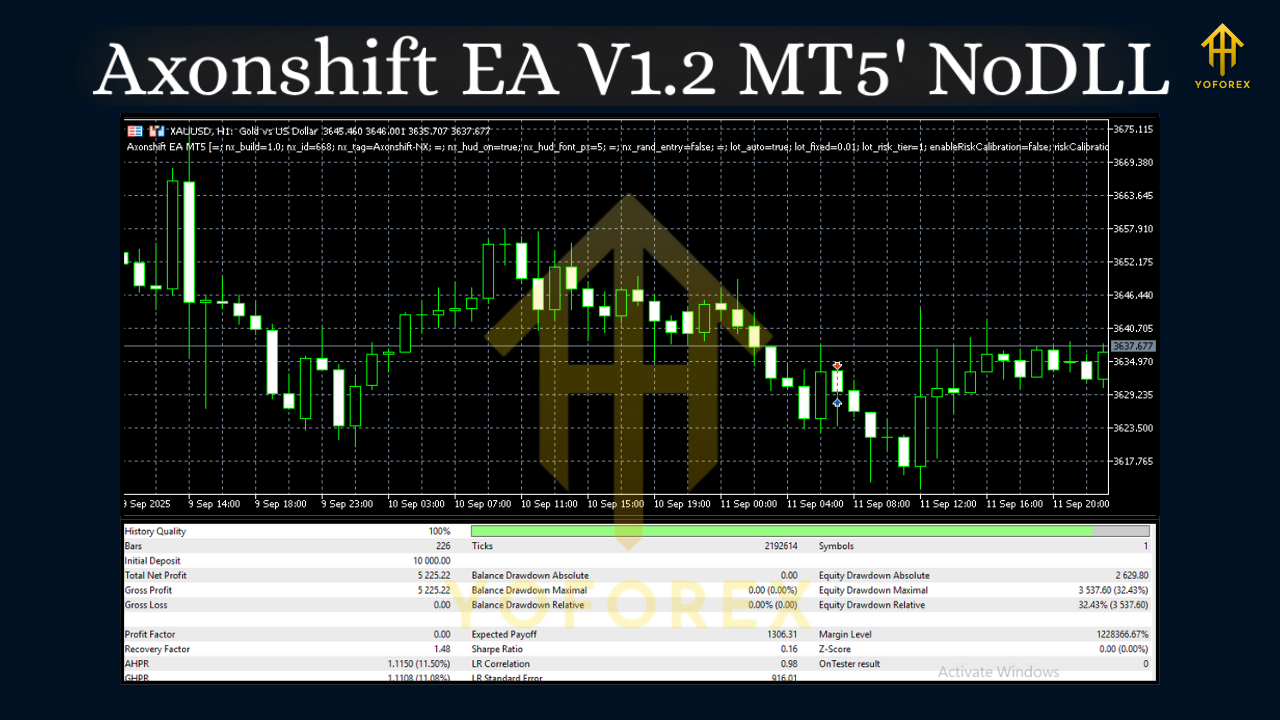
How AxonShift “Thinks”: The Structured Logic Modules
Think of AxonShift as several small, focused brains working together:
- Signal Discovery Module — Detects short-term pressure (momentum bursts, micro-breakouts, and snapbacks) that frequently precede H1 moves on Gold.
- Trend Context Module — Evaluates the intermediate trend to avoid fading strong moves or chasing late.
- Volatility Filter — Checks if the current ATR/true-range environment is tradable. Too quiet? Skip. Too chaotic? Reduce exposure or stand down.
- Risk-Control Module — Applies fixed-fractional risk and position caps; never escalates via martingale.
- Trade Lifecycle Module — Handles entries, staged exits, breakeven, and optional trailing. Keeps each trade within a controlled cycle to avoid long, unmanaged exposure.
- Session/Timing Guardrails — Limits trading to preferred hours if you choose (e.g., overlap sessions), reducing late-session noise.
These modules are simple to reason about and easier to maintain than a giant, opaque neural net. You’ll know why a trade is taken, and you can audit each part of the decision flow.
Strategy in Plain English
- Identify a tradable impulse on the H1 chart (short-term momentum or a structural micro-break).
- Confirm with the intermediate trend so the trade aligns with broader direction instead of fighting it.
- Enter with predefined risk—the lot size and stop loss are determined up front.
- Manage with guardrails:
- Hard Stop Loss (often ATR-based),
- Optional breakeven once price moves in your favor,
- Optional trailing to capture extended runs,
- Take Profit set by a distance multiple or structure level.
5. Exit cleanly and wait for the next fully aligned setup; no impulse-chasing sequence, no grid layering.
This rules-driven flow is what keeps AxonShift out of trouble on those messy Gold days.
Installation & Quick Start (MT5)
- Copy the EA file into
MQL5/Experts/in your MetaTrader 5 data folder. - Restart MT5 or hit Refresh in the Navigator panel.
- Open XAUUSD (Gold) H1 chart.
- Drag AxonShift EA onto the chart and check Allow Algo Trading.
- Set your inputs (see baseline suggestions below).
- Ensure the AutoTrading button at the top of MT5 is green.
Baseline Input Suggestions (adjust to your risk profile):
RiskPercentPerTrade: 1.0–1.5% to start (prop-friendly); scale to 2% only after forward tests.MaxOpenTrades: 1–2 (keeps cycles controlled).StopLossATR_Multiplier: 1.8–2.5 (wider in manic volatility).TakeProfitATR_Multiplier: 2.5–4.0 (reward > risk).EnableBreakEven: true after +1R move.EnableTrailing: optional, trail ~1.0–1.5× ATR once trade is in profit.TradingHours: Restrict to London–NY overlap if you want tighter execution conditions.MagicNumber: Unique ID so AxonShift doesn’t conflict with other EAs.
Environment Tips
- Choose a low-spread, low-latency broker for XAUUSD.
- Consider a VPS near your broker’s server if your local connection isn’t stable.
- Keep slippage realistic (not zero). Real-world conditions matter.
Backtesting & Verification (The Right Way)
Gold is volatile; sloppy tests can mislead you. Here’s a robust process:
- Modeling: On MT5, use “Every tick based on real ticks.”
- Data span: At least 2–3 years across different volatility regimes.
- Spread: Let it vary; fixed ultra-tight spreads can disguise risk.
- Walk-Forward: If you optimize, split your period (e.g., 70% in-sample, 30% out-of-sample). Then walk the parameters forward.
- Monte Carlo: If available, run trade sequence shuffles to see how results react to different fill orders and random slippage.
- Forward Test (Demo): Run AxonShift for 3–6 weeks on demo with your chosen risk. Confirm behavior in live market conditions before going real.
You’re not looking for a “perfect” equity curve—that’s often a red flag—so much as smooth, bounded drawdowns, consistent logic, and solid risk-adjusted returns.
Risk Management & Prop-Friendly Habits
AxonShift avoids martingale and keeps trades bounded, but you control account-level risk:
- Per-Trade Risk: 0.5–1.5% is a sane default.
- Daily Drawdown Guard: Consider pausing the EA if daily loss hits 2–3% (prop-firm friendly).
- Max Concurrent Exposure: Keep
MaxOpenTradessmall; single-instrument concentration is already high. - Capital Split: If you run multiple systems, separate them across accounts so one EA’s drawdown doesn’t sink the whole ship.
Remember: even great logic runs through imperfect execution (spreads, slippage, news spikes). Protect your downside first.
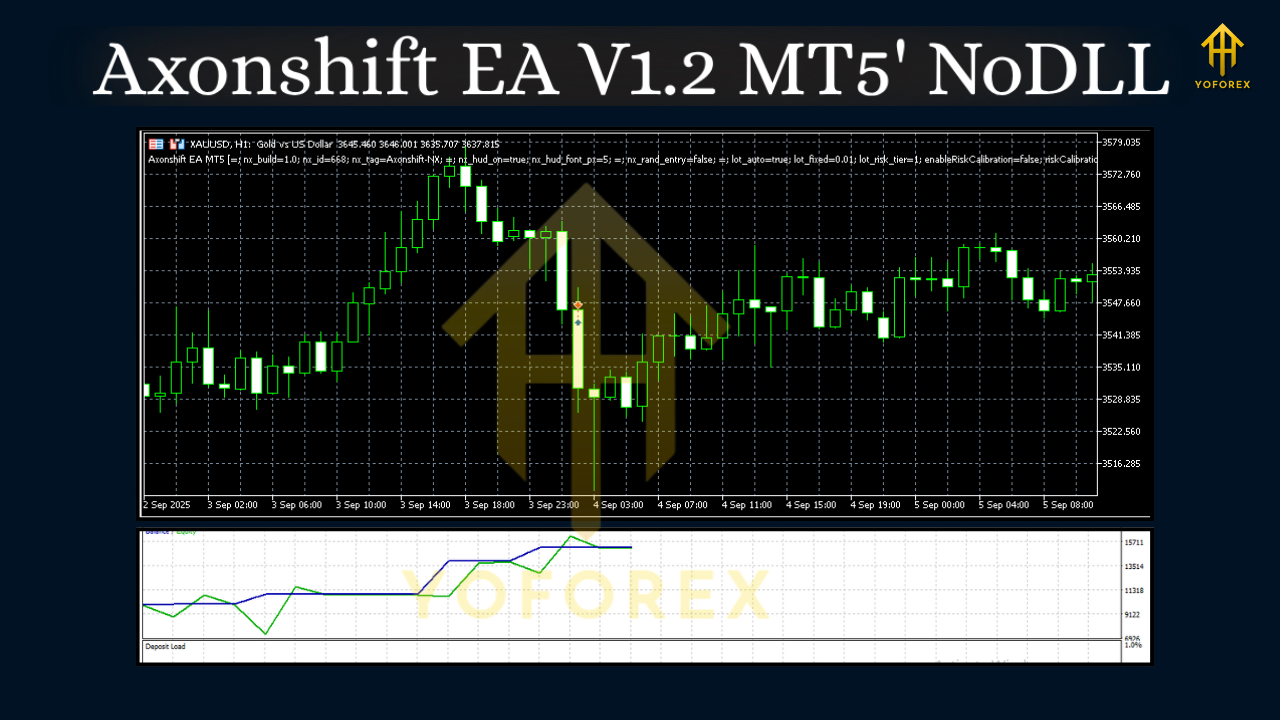
Optimization Without Overfitting
If you tinker with parameters, do it with intent:
- Focus on risk knobs (RiskPercent, ATR multipliers, MaxOpenTrades).
- Avoid chasing the last 3 months; use multi-period robustness checks.
- Prefer simple, stable settings over hyper-tuned ones.
- Lock a set, forward test, and only then consider minor refinements.
The goal isn’t the highest historical profit; it’s durability.
Who Is AxonShift For?
- Traders who like clean, rules-driven systems, not black boxes.
- Gold (XAUUSD) fans who appreciate H1 rhythm—not frenetic scalping, not sleepy swing holds.
- Prop-firm candidates who must respect drawdown caps and limit impulsive over-trading.
- Anyone fed up with martingale, grid pyramids, and “ten trades a minute” madness.
Practical Playbook (Day-to-Day)
- Before London open: Check if AxonShift is enabled and risk is sane.
- During London–NY: Let the EA operate; don’t override entries unless there’s a hard rule breach (e.g., broker outage).
- After New York close: Review trades, export statements, log notable market events.
- Weekly: Assess performance vs. your plan; don’t tweak inputs reactively.
- Monthly/Quarterly: Consider parameter hygiene and walk-forward checks.
Final Word
AxonShift EA V1.2 MT5 doesn’t promise magic. Instead, it delivers a structured, auditable approach to trading one of the most lucrative yet temperamental instruments on earth—XAUUSD on H1. If you want measured exposure, well-defined risk, and a system that trades when it should (and stands down when it shouldn’t), AxonShift’s controlled trade cycles and module-based reasoning make a compelling case.
Comments
Leave a Comment